A Newark group takes on the NJ prison industrial complex
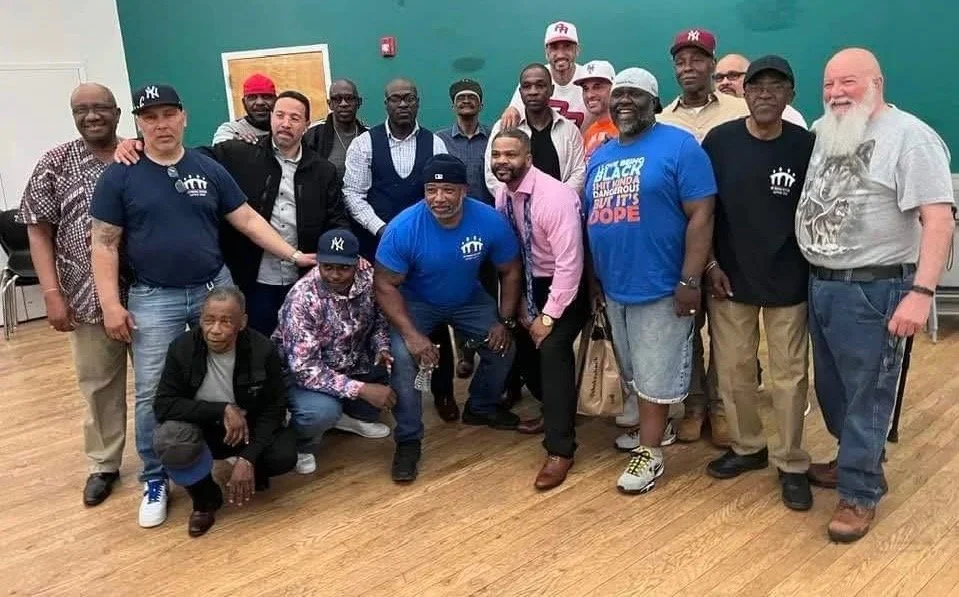
Returning Citizens Support Group (RCSG) Founders Al Tariq Witcher and brothers Carmelo and Chino Ortiz join with fellow members of the weekly Thursday night huddle. Photo credit, Al Tariq Witcher.
When Al-Tariq Witcher and brothers Carmelo and Chino Ortiz founded the grassroots activist organization, Returning Citizens Support Group (RCSG), they sought to offer the support that they didn’t receive when they exited prison.
Witcher had served a 20-year sentence, and the brothers 30 years each; in that time, the world outside had evolved without them, and upon the end of their time served in 2011 and 2016, respectively, they returned to a world of new technologies powering new political and socio-economic lifestyles.
They founded RCSG in 2017, and now, nearly a decade later, they’ve built a space where returning citizens can transition back into their communities. RCSG is both a resource-sharing organization and a union that advocates for humane conditions and rights for people who are incarcerated, having successfully advocated for several new laws under former Governor Phil Murphy, including restoring voting rights to people on probation and parole and allowing returning citizens to serve on juries. Their advocacy work, said RCSG organizer Nicole Guyette, is meant to “organize, build power within our community, and be able to affect legislation on things that matter to us.”
While RCSG mainly operates in the Newark area, it is ever-expanding, with operations in nearby areas including Camden.
One of the advocacy group’s most critical services is its weekly support group at its Newark location, where, for two hours, returning citizens find comfort sharing their stories with those who truly understand. Guyette recalled the nerves and warmth she felt sitting in a small circle of about 20 people when she first joined in 2020.
Today, that once modest room is filled with almost three times as many participants, each seeking connection, empathy, and the reassurance that they are not alone.
Many of RCSG’s services are practical—helping returning citizens obtain monthly bus passes for transportation or work documents—but others, like the support group, are deeply committed to nurturing emotional well-being and rebuilding trust in oneself and the community.
When possible, RCSG greets returning citizens as soon as they exit prison facilities. Through a network of social service agencies and tips from families, RCSG organizers are alerted to prepare for the return of community members, learn of upcoming release dates in the Newark area, and station fellow members to greet returning citizens with information and greet newly-released community members at the gate with a backpack filled with donated toiletries, gift cards, and sometimes clothing.
From there, RCSG’s organizers offer support depending on what the returning citizens need. There is no one-size-fits-all service. If, upon exit, a returning citizen does not have family members waiting to take them home, RCSG’s organizers would take them to a shelter. Because prison facilities do not provide state IDs to returning citizens, RCSG’s organizers take them to the Social Security office and walk them through the process of procuring one. A partner at Franciscan Charities helps them get birth certificates. “We have a lot of different contacts to help us out,” Witcher said.
RCSG employs several methods to acquire resources for its operations. For instance, Witcher said that when he exited prison in 2016, he got a job at UPS on his own but began recommending other returning citizens to his employer. In other cases, RCSG organizers use word of mouth, sharing job postings from online mailing lists they’ve subscribed to. RCSG also has a close relationship with other entities, including the New Jersey Step Program, a higher education program hosted by Rutgers University that assists returning citizens with their transition into college life after incarceration.
“We have this ecosystem of people,” Witcher said.
“Our families don’t understand the things that we went through while we were behind the wall,” Miseka Diggs, one of RCSG’s members, said. There is a stigma behind talking about their experiences, she added, but people—including her—found a familial connection with RCSG through its weekly support group. “So being in that space, that’s an extended family with no judgment that understands what it’s like to be incarcerated, and that’s where the relatability comes in.” The room bursts into applause when they share their achievements, including the recent releases of newcomers.
RCSG is further expanding its support group by offering separate sessions for men and women. “A female may not feel comfortable speaking about abuse or whatever trauma it is that she went through in front of a male, right?” Diggs said. “And a male, vice versa, may not feel safe getting vulnerable around women.” Diggs, who founded the women’s support group, expects to launch its first session next month.
Making a bridge
Reflecting on his time in prison, Witcher said that his life was limited to the cell. He had one spoon for his food, and everything—bathroom, shower, snacks—was within that one room. Because sentences like his could stretch on for decades, leaving prison was like stepping from one world into the other.
Echoing this sense of disconnection, Carmelo said, “Inside the prison is a totally different culture. People get castrated emotionally.” In prison, he recalled, people survived by avoiding confrontations. However, after exiting prison, they find it difficult to communicate or resolve conflicts with their loved ones.
Carmelo recalled one instance in which the wife of a member came to RCGS after her husband walked out during an argument. “He would leave at two o’clock in the morning,” he said, and was himself surprised when the wife continued to say that she was worried for him; while in prison, Carmelo said, they did not have to consider how their actions would affect their loved ones. “And so that’s good to know, because a lot of us are not aware of that,” he added. “We have to take that into account, right? Before we just make a decision to leave in the middle of the night.”
People in prison are “respectful,” Carmelo said. “Nobody’s trying to live in the same environment with somebody they have a bad relationship with.” When Carmelo was released, he recalled hearing someone on the sidewalk saying, “Good morning.”
When he greeted him immediately, he was surprised to get no response. He eventually realized that the pedestrian was speaking through his AirPods.
“So, a few weeks ago, I thought people were trying to be polite, and the truth is, they weren’t even talking to me,” Carmelo said. RCSG also offers an eight-week Digital Literacy Course at its Newark location to catch people up to speed on technology.
Building community
In 2025, RCSG served 450 community members. There is no one-size-fits-all way RCSG helps its members; each person has their own individual needs. Member Sammy Quiles, who was incarcerated at 17, checked into a halfway house when he finished serving a 30-year sentence.
Reflecting on his supportive experience, Quiles said, “They’ve been here through this whole journey, celebrating my successes and my transformation.” Inspired by this support, RCSG’s regulars and organizers now find ways to give back. Quiles always makes an effort to show up.
“This guy calls me at eleven o’clock on a Saturday when I’m doing my groceries,” he said, “like ‘Yo, I’m at a church and I need help tabling an event.’ And I’m like, ‘All right, give me an hour.’”
Such a small, everyday task “may not seem like a big deal or may seem frivolous to other people,” Nicole Guyette, an RCSG organizer, said. “But they’re things that could sometimes be triggering to us.”
“They’ve been here through this whole journey,” Quiles said, “celebrating my successes and my transformation.” Because of that, RCSG’s regulars and organizers find ways to give back. Quiles always makes an effort to show up. “This guy calls me at eleven o’clock on a Saturday when I’m doing my groceries,” he said, “like ‘Yo, I’m at a church and I need help tabling an event.’ And I’m like, ‘All right, give me an hour.’”
Since joining RCSG in 2023, Quiles has become a case manager in The Center for Justice Innovation’s Alternatives to Incarceration Program, helping community members avoid paying fines or serving jail time for low-level offenses such as disorderly conduct. Because Quiles often communicates directly with prosecutors and judges in this role, he has become an advocate for his community members.
“How are you gonna give a person who is going through housing insecurity and doesn’t have access to a cellular device an open warrant for missing municipal court?” he said.
It’s got to change
As an adolescent, Quiles fled a violent home and ended up on the streets. With nowhere to turn, he eventually joined a gang.
“The criminal legal system was never responsible for me when I was that young child,” Quiles said. “However, as soon as I committed a violent crime, all of a sudden, the justice system was responsible for me.”
Recently, Chino spoke out in support of the Incarcerated Women’s Protection Act, which would require the state Department of Corrections to mandate annual gender-specialized training for correctional officers overseeing imprisoned inmates, in an effort to prevent sexual misconduct.
Chino is now focused on Ubuntu Village—a housing project that would reserve 25% of its apartments for people returning from incarceration. The building, which RCSG is developing in conjunction with Nehemiah Rising and Essex Together, would also include ground-floor offices and community space where RCSG can continue to offer on-site services to community members. Some of the services they currently offer are first-time homeownership and financial literacy workshops, providing the formerly incarcerated with the education to build generational wealth.
“I used to put a lot of pressure on me because I used to think, ‘There’s going to be a day where I’m gonna feel normal,’” Quiles said. “But I’m perfectly fine being abnormal, if that’s even a thing, and I’m just going to continue.”