
“Stand up, fight back”: New York, New Jersey climate action takes shape
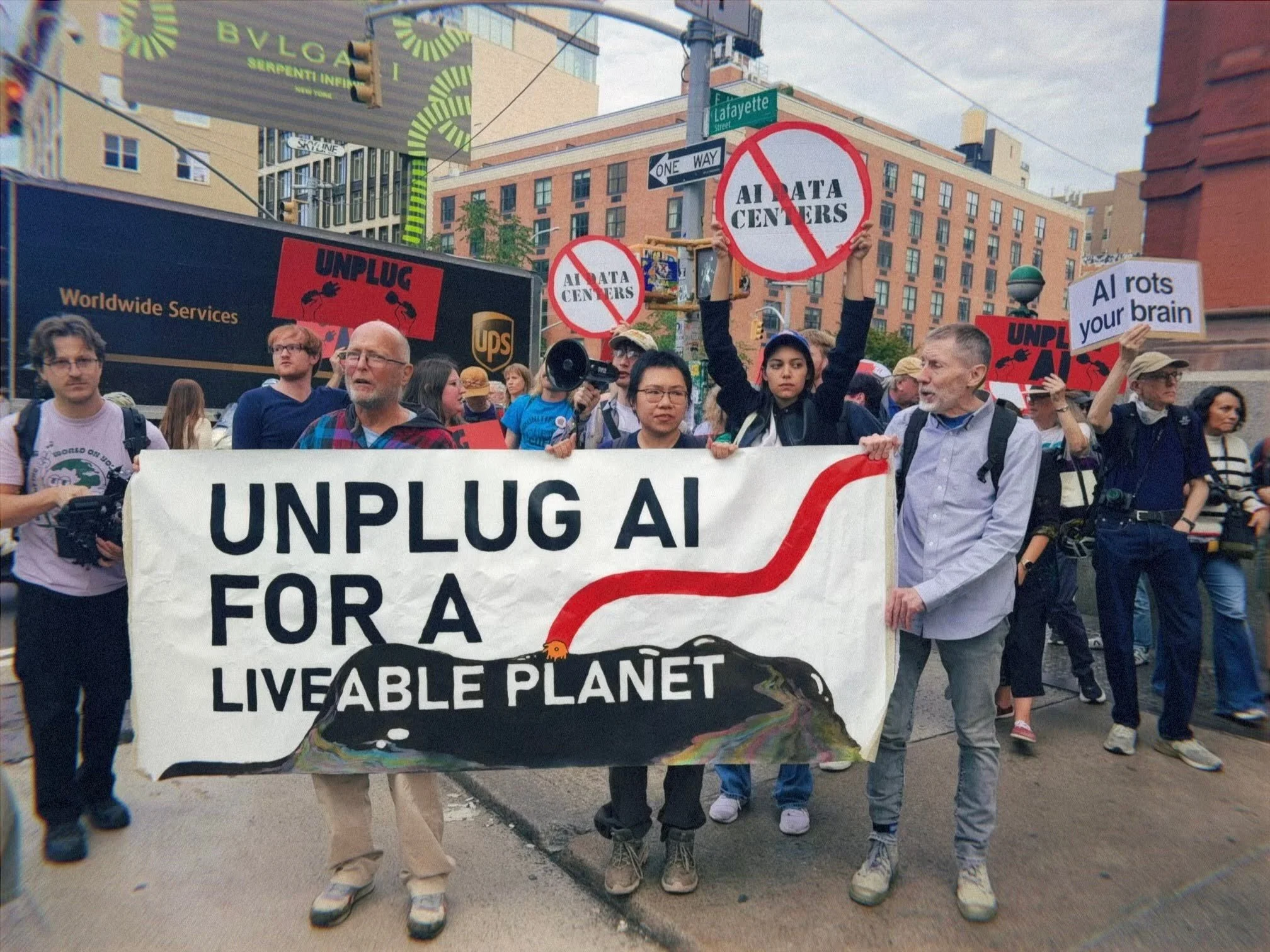
Activists take to the streets to protest the impact of AI and the growing rate of data centers on the environment at the annual Climate Week of Action in NYC on September 21. (Photo credit, Abigail Kim for Public Square Amplified.)
NEWARK, NJ—According to the World Health Organization, 3.6 billion people reside in areas susceptible to climate change, with an expected 250,000 deaths per year between 2030 to 2050. 37% of heat-related deaths— the percentage rising to 70% for those over 65— are due to climate change. Research shows that Black and Brown, and low-income communities, also known as environmental justice communities, are disproportionately impacted: climate change is both an environmental and social injustice whose effects are not borne equally
This makes it no surprise that climate weeks are increasingly taking place across the globe. Since 2022, there have been over 500 mass demonstrations related to climate policy. Current movements coincide with the United Nations General Assembly meeting in New York City during September to December each year, where world leaders from 193 nations convene to discuss global conflicts, AI technology, and human rights. These conversations include climate change, where multiple leaders recognized the need for action, including Luiz Inacio Lula da Silva, president of Brazil; Shisir Khanal, minister of foreign affairs for Nepal; and Sanae Takaichi, prime minister of Japan, among others.
Ghana president John Bramani Mahma echoed these sentiments: “Melting glaciers, flash flooding, droughts, record-breaking heatwaves, brush fires, hurricanes and other extreme weather phenomena are unmistakable signs of an overburdened planet. Climate change is the ultimate test of global equity,” he said.
Climate change’s effects extend beyond the environment, impacting people— particularly, environmental justice communities, who already face pollution and health disparities.
“For me, the focus is the people. Like the quality of life, living conditions, health disparities, the challenges that the Black and Brown community face around air quality,” said James Lavor Thompson, who has helped nonprofits, labor unions, businesses, foundations, and more organizations for over 20 years. “Environmental justice is about people and for people.”
The push for political action comes at a time when the United States is removing itself from major climate treaties— namely, the Paris Agreement, which identifies specific goals for mitigating climate change and aims to limit temperature increases to 1.5 degrees celsius. 194 nations are a part of the Paris Agreement. Other organizations the U.S. has withdrawn from include the 24/7 Carbon-Free Energy Compact, Commission for Environmental Cooperation, Intergovernmental Panel on Climate Change, UN Framework Convention on Climate Change, and many others.
Meanwhile, the U.S. gains 83.17% of its primary energy from fossil fuels, will generate 1 billion tons worth of plastic discarded waste, and pays around $150 billion each year for climate damages. At the same time, AI has raised its own concerns. 3,000 data centers are located in the U.S., with more than 1,500 expected to be built nationwide: these data centers are criticized for producing waste heat, the heat generated by computing, releasing it into the atmosphere. In fact, waste heat can raise surrounding temperatures by as much as 16 degrees Fahrenheit and close neighborhoods’ by as much as 4 degrees Fahrenheit.
Disproportionately burdened with these effects, environmental justice communities continue to be threatened as data centers become increasingly situated within them. Historically, these communities have been targeted as areas where corporations place toxic polluting facilities, with little means to relocate away from the dangerous environment.
“There will be spaces where people will say, what's wrong? And we have to say, one of the big factors here is race. We can no longer put in all the polluting facilities in these communities,” says Nicky Sheats, the Director of the Center for the Urban Environment at Kean University. “A big reason that's been sustainable (in the past) is because of all the pollution in environmental justice communities.”
New Jersey has over 66 data centers, the majority of which are located in Newark, Secaucus, and Piscataway. In Vineland, New Jersey, Data One— NJ’s largest data center, currently under construction— was fined $1 million on September 22 for the operation of 62 natural gas generators without required permits from the Department of Environmental Protection.
Though they emit fewer pollutants than burning oil or coal, natural gas generators still emit pollutants through combustion. Governor Sherrill pushed against a statewide moratorium on data center construction, instead urging local governments to make their own decisions on data center placement.
“If a data center says, ‘Look, this is what we’re proposing in this industrial park, and we’re also going to invest in your K-12 curriculum, or we are going to build a community center, we’ll do that,’ that’s something the towns can determine,” Sherrill said in a statement to Politico.
On the other hand, Governor Kathy Hochul implemented a one-year moratorium on data center construction, a decision that the Siena Research Institute found that 46% of New Yorkers support. New York has around 135 data centers.
From Sept. 20 to 27, New York City Climate Week, the largest annual climate event in the world, brought together political and business leaders, community members, and nonprofit organizations to promote climate action. Coinciding with the week, the multigenerational and multiracial action home Climate Defenders organized its “Unplug AI Week of Action”.
Protesters targeted corporations including OpenAI, Amazon, and Google offices, as well as the Gowanus Fracked Gas Plant. Demonstrations included calls for data center moratoriums, criticisms of “greenwashing”--- deliberate reframing of corporate activities to sound environmentally friendly— and condemns of the harm to communities caused by data center construction, among others.
Daisy Maldonado, a community organizer with Fight Chihuahuan Desert Xtraction (FCDX), spoke outside OpenAI’s office on the 21st. FCDX is a response to Project Jupiter, a $165 billion AI data center project in New Mexico backed by OpenAI and Oracle.
“Every gallon that they take is a gallon taken from our kids, is a gallon taken from our future,” Maldonado said. “Our demands are simple: an end to all data center expansion in our community and communities across the country, an end to fossil fuel expansion, and for the government to regulate all AI companies — and no AI bailouts.”
The protests aim to signal government leaders that climate policy is an urgent matter. For Dr. Sheats, New Jersey’s Bill S232— which requires the NJDEP to consult environmental justice communities when evaluating pollution-related permits, among other protections— has been a significant policy endeavor. S232 was passed on Sept. 18, 2020 and supported by over 165 organizations including the New Jersey Environmental Justice Alliance, which Dr. Sheats co-founded.
“For two decades, we advocated and had coalitions. Without that, we wouldn't have gotten there. And tell you the truth, we were ready to keep going for two more decades,” Dr. Sheats said. “What made the policy such that the state would even think about adopting it? That was because all the work in advocating the coalition building, all the meetings, all the testimony. And then it's a strong law, it's no longer a bill.”
The work behind S232 is indicative of the reality of climate advocacy: policy developed through sustained organizing. Across climate movements, the process of coalition-building, raising public awareness about community environmental harm, and pressure on policymakers are part of a larger demand for change. For advocates, that requires persistence, even through uncertain progress.
Thompson echoed the importance of continued action: “It is important for community leaders to have a thorough understanding of how long some of these battles take. It’s not a week or two weeks or six months, in some cases, it could be anywhere from 18 months to 10 years. Make sure that there's constantly new folks that are coming into the process.”
As climate challenges persist through generations, young leaders are finding ways to contribute to the movement. “There are so many things that you can do in the climate change space to help move it forward,” said Sagorika (Sage) Biswas, the founder of Root for Change, a student-led climate initiative.
Root for Change hosts climate education events, connects young people with advocacy resources, and uses art, science, and innovation campaigns to encourage climate action. “It's never really too late to do something. I know it might seem that way, but it’s not. If you see all of the innovations that people are making right now, it's truly inspiring to see them come together.”
Ultimately, continued collaborative action is central to advancing environmental justice, as communities collectively work toward a future where environmental protections are accessible to all.
“Don't give up. I often say, it's almost like living in an afterlife. You have to believe that your community will get to the goal they have set. It could be right around the corner. Or it could be a long time. Take care and take advantage of any opportunities,” Dr. Sheats encouraged.