In conversation with poet and activist Julia Wright | ‘For the Baby Ancestors in Gaza’
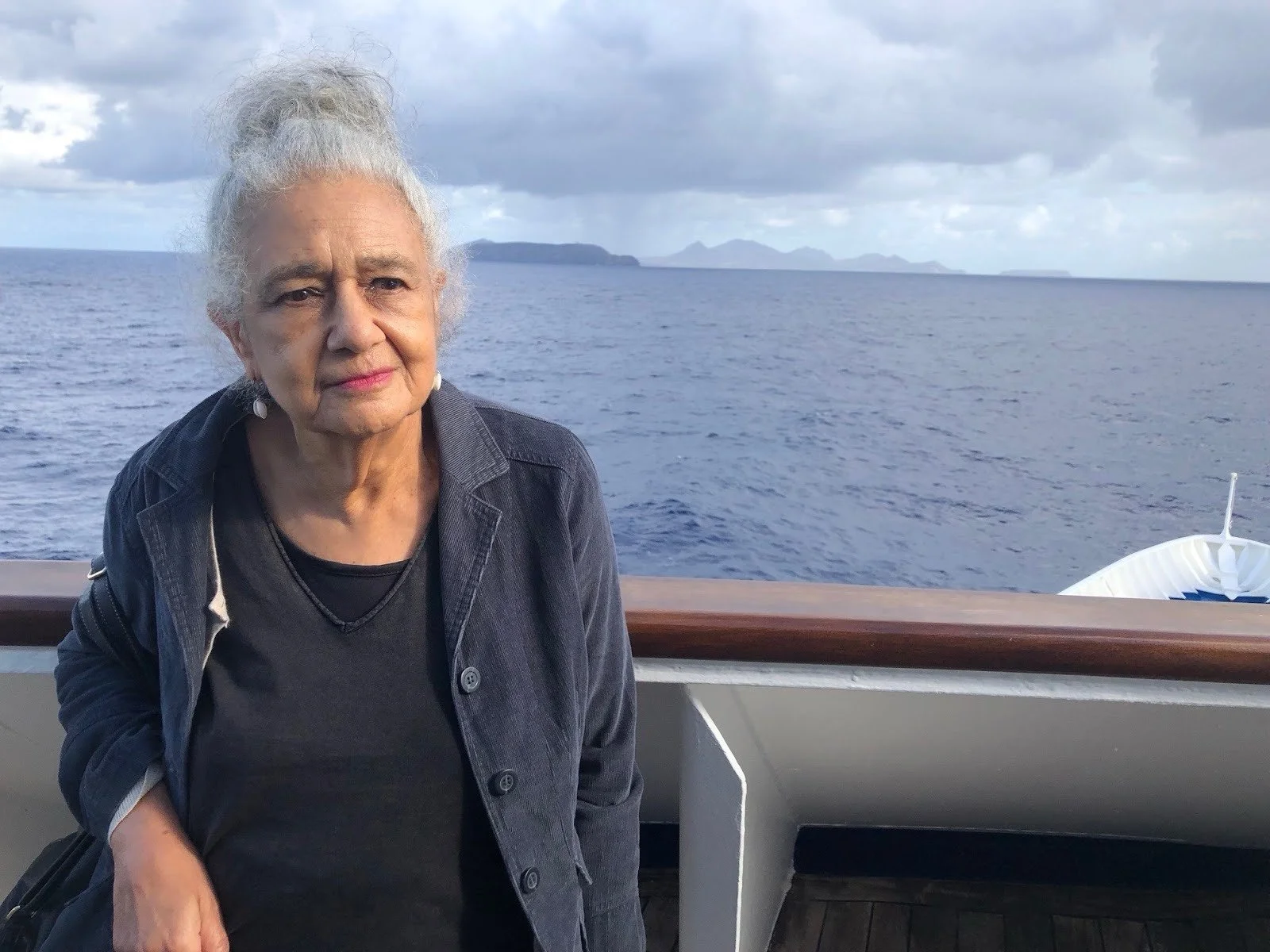
Julia Wright is the elder daughter of the late African American novelist, journalist, and poet Richard Wright; and a journalist and a poet, in her own right. Photo Credit: Malcolm Wright
Newark, NJ - A new collection of poems from poet and activist Julia Wright wrestles with the question of what a poet’s role is in Israel's years-long bombardment of Gaza, which the World Health Organization says has killed upwards of 70,000 people, more than 20,000 of them children. Besides the mass killing, the strip has the highest number of child amputees per capita anywhere in the world.
For the Baby Ancestors in Gaza, published by the Moratorium Now Coalition, is in its second printing. Her book directly benefits the aforementioned coalition that advocates stopping foreclosures, evictions, and utility shutoffs, thereby testifying to Julia Wright’s activism in practice, as well as in language. At a time when the chase for a successful career has penetrated poetics and language stamped with commercialism is priced over the language of the people, Wright’s work offers a way to witness and a possibility to build differently.
Wright’s family history reflects the long struggle for racial justice in America. Her father was the acclaimed novelist and essayist Richard Wright, whose 1940s novel “Native Son” and memoir “Black Boy” drew attention to the lives of Black Americans under Jim Crow. Her great-uncle, Silas Hawkins, was one of the scores of Black tenant farmers killed in the 1919 Elaine Massacre in Arkansas after they tried to organize for higher wages from white landowners.
Wright carries on that legacy through activism and poetry. A Pan-Africanist, she was one of the founders of weekly rallies that, since 1995, have been held at the U.S consulate in Paris to support Mumia Abu-Jamal, an activist who was convicted for the 1981 murder of a police officer. Those who believe he is innocent hold him up as a symbol of racial injustice, and the rallies are intended to also throw light on the elder abuse and medical neglect in prisons.
The poetry collection is deeply informed by Wright's efforts in social justice movements. Its foreword is written by Yousef M. Aljamal, a student of Palestinian poet and professor Refaat Alareer, who was killed by Israeli Occupation Forces in Gaza on December 6, 2023. Alareer’s centrality is felt in Wright’s opening haiku, which commemorates "the smile of a lost poet/reaches out past Time". Aljmal writes, "We should continue to tell this tale, the Gaza Tale, every day until Palestine is free". Wright's book answers this call by documenting specific dates and atrocities inflicted on Gazans.
Acclaimed Palestinian poet Naomi Shihab Nye has praised the collection, saying, “Wright's poems remind us who we want to be and might have been.”
Public Square Amplified spoke with Wright about some of these ambitions and might-have-beens.
In Conversation with Julia Wright. This interview has been edited for clarity.
Gauri Awasthi: I was deeply moved by the Author’s Introduction of the book where you say, “The context of the selection of poems you are about to read raises more and more questions about western poetry in solidarity with those resisting the genocide in Gaza.” Your own writing is, of course, a testament to the kind of poetics that speaks to this genocide. Can you tell us more about the role of poetics in times like ours?
Julia Wright: My real initiation to poetry did not occur in elementary school, but later, aged 16, when I saw my father write literally thousands of haiku feverishly during his last illness in 1960. These haiku that could be uttered in a single breath, because they are the shortest known form of poetry (17 syllables or 11 syllables), suited his failing breath. But also, these Japanese-style poems he was composing in English suited him as the writer who had gone to the Conference of Non-Alignment in Bandung in 1955, where he met others who wrote against the Western grain.
Our situation as writers and poets in the belly of the beast, faced with the imperial wars our taxes pay for, is paradoxical. On the one hand, we owe it to our sisters and brothers in Gaza to give them the mic, not speak for them or over them. However, what they are going through is so unspeakably tortuous that, as one of them says after his release from an Israeli prison, “There are things one simply cannot talk about. There are words one can’t even say to anyone, even to myself”. So how do we as poets, as witnesses, capture what is unspeakable while those who would best know how to speak of it, if only they could, need silence to heal?
Our poetry is at best imperfect, unfinished, a stopgap. But our solidarity makes it imperative.
GA: The titular poem of the collection Baby Ancestors in Gaza is dedicated to “the tiny children /
who become ancestors/ each day”. I was moved by the idea of babies as ancestors, which sounds like an oxymoron in the way we perceive language, but Gaza has changed what we understood/understand about language. Can you speak to this phrasing and how it came to be?
JW: Poetic images are not always easy to explain; they are over-determined, I think.
I was always very moved by my favorite novel by my father, called “The Man Who Lived Underground” (Library of America, 2021), where Fred Daniels keeps seeing dead babies during his journey through the sewers,since the manuscript was written during my mother’s pregnancy with me in 1942.
Beyond the personal, one of the quotes from Amilcar Cabral I keep returning to is: “We must act as if we answer to, and only answer to, our Ancestors, our children, and the unborn”.
To this day, although I had no difficulty juxtaposing the two nouns, for the world of me. my imagination fails to conjure what a baby ancestor might actually look or feel like. Another instance of the unspeakable. The whole poem is an attempt to tame a reality that escapes the ability of the mind to visualize.
GA: In the Author’s note at the beginning of the book, you also mention daily journaling after October 7th as you continued to write towards Palestine. There is a deep sense of documentary poetics to this work, then, especially as you embedded many direct quotations from new cycles, or the claims made by Israel, into your epigraphs, like when you mentioned in the poem “In The Gazan Way of Death”: There is no genocide in Gaza because there are no gas chambers there. - One of the arguments to be used by Israel at the ICJ against South Africa's case of genocide in Palestine. What led you to those specific epigraphs?
JW: Again, there is the need to tame the horror, not to get used to it, but to capture it in words - or “near-words”.
Here, Refaat Alareer’s kite metaphor guided me.
GA: Can you explain this kite metaphor further?
JW: Like so many children in Gaza, Refaat Alareer enjoyed kite-flying and taught it to his own children. In his iconic last poem, "If I Must Die", the kite made by the child who is left behind becomes an intergenerational tail, and the tale of strings and glue enables a father who could not say goodbye before "the blaze" to communicate his hope of continuity.
My personal interpretation, Refaat's kite is also an attempt to rise above the genocide and the war crimes on the ground by defying gravity so that the kite soars past the Iron Dome, where it cannot be shot down.
To my mind, Refaat’s kite is an attempt to rise above the genocide and war crimes on the ground by defying gravity so that the kite soars where it cannot be shot down.
Refaat’s kite was his poetry soaring above the IOF soldiers who ended up shooting him, the kite-maker, down. It felt fitting to offer YouTube links or links to quotes so that the reader can gauge how high the kite of my poem was able to rise above the horror.
GA: In the poem, “Dead Child Walking” which is dated March 15-17, and you dedicate to ‘For the Mumia Youth Movement and the Palestinian Youth Movement’, you evoked Rami Al Halhouli, “who was celebrating Ramadan /playing with a firework/ is murdered by the IOF / in front of our eyes - /another Tamir Rice - /whose body pierced by / a bullet made in USA.” I felt the voice of a poet building solidarity across race and borders. What is your experience with the role of poetics in building such solidarity?
JW: We know our radical Black movements in the United States were led by children or youth from SNCC to the Panthers. We know that in Gaza and the West Bank it is the children who are targeted because they are considered the next generation of freedom-fighters and just as Gazans are considered animals, their children are considered devoid of innocence. The revelations of how the Epstein class used – still uses – children confirms that if we are busy protecting butterflies and other species from extinction, we are still far behind as far as children are concerned. And uprooting the seed is the intent of all genocides everywhere.
GA: The deep influences of the ancestors you are in conversation with — be it Bessie Smith’s song, the words of Assata Shakur, or the haikus of your father Richard Wright or his library, also uphold the threads of the book. What does it mean for you to pull them into this work?
JW: I was in Guinea, West Africa, when Amilcar Cabral pronounced his 1972 speech called ”The Cancer of Betrayal” in front of Kwame Nkrumah’s coffin. I remember his words as if it were yesterday : “ In Africa, the dead live among the living. In Africa, each dawn, the dead walk at our side”. Richard, Assata, Refaat, Imam Jalil Al Amin - all those we have lost have left us with a legacy, a dream and a protection. As Dr. Joy James says: “We are so much more wealthy than we know”. And she was not speaking dollars – she was speaking resilience and ancestral wisdom.
Assata entreated us to look away from the dead not only because they have stopped suffering but because we carry them within us. She would have us turn from the dead to save those who are still alive. I understand her counsel because it is always time to integrate the wisdom and love of the ancestors in everything we do, from libation to poetry.
GA: I was moved by the words and also the images. Can you speak to the decision to include the images you did in the collection?
JW: Here I want to thank the editor-in-Chief, David Sole, of Fighting Words as well as the whole team, Michael Shane,Tova Fry, and Verbena Lea for their encouragement. They are the ones who asked the Pan Africanist editor of panafricannews.blogspot.com, Abayomi Azikiwe, if he would contribute some of his photographs, and he accepted. I was delighted because these illustrations send us back to my father’s Pan Africanist convictions.
Like the youtube links, photos are powerful because they ground us in the reality of the cruel and inhumane. I remember the importance my father attached to photography throughout his life.
GA: Lastly, as the genocide in Gaza ensues, what advice do you hold for the writers, poets, educators, students, and organisers? Especially as you talk about the learning of languages, even of the oppressor, and what it means to reclaim using them and remain in conversation with Refaat Alareer?
JW: We, those whose land was stolen, do not speak our own language. Our language was stolen from us as well. It was Mahmoud Darwish who asked questions in his work along the lines of: Can you live in a language, when you cannot live in a land?
I think Darwish’s answer was “yes” and that his poetics are a testimony to his living in a language as if it were a land. In his case, Arabic.
Both Refaat Alareer and my father reclaimed the master’s language, the better to subvert it and create their own masterpieces with it. The reality of language as land is very empowering and healing.
The other crucial thing I would say is that writers, educators, poets, and journalists all have in common is that they have the power to bear testimony to the genocides – whether in Gaza, Sudan, Congo, and now in Lebanon. Words are weapons, and using them to speak the truth about the genocides to power is a winning strategy in the war of narratives.
The proof can be found in the legal targeting of poets like Refaat Alareer, of the journalists in Palestine, the threats against the teachers of UNRWA, and now increasingly the arrest of US journalists by ICE in the belly of the beast.
May we hold on to that power.