
‘The very least we can do’: NJ Climate Superfund Act to help fund critical infrastructure
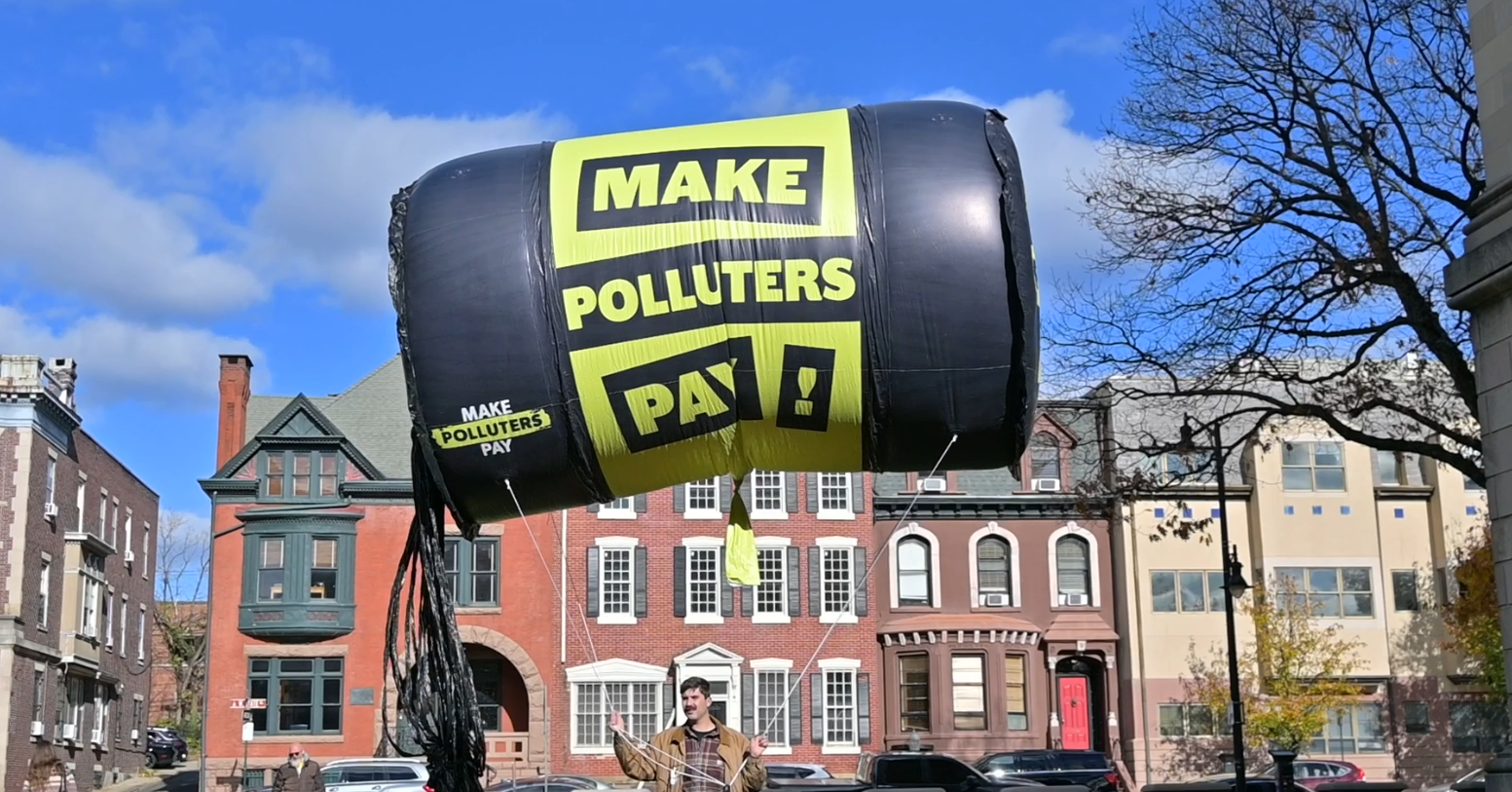
Activist holds a “Makes Polluters Pay” balloon at a rally supporting the Climate Superfund Act in Trenton on Nov. 17. Photo by AB Youssef.
Trenton, NJ - The NJ Legislature is close to passing the Climate Superfund Act, which would compel companies liable for pollution and ecological destruction to pay $50 billion to fund part of the cost of climate adaptation projects. Proponents of the bill, modeled after similar legislation in New York and Vermont, hope it is passed in time for outgoing Governor Murphy’s signature in January. The Senate Budget and Appropriations Committee will hold a hearing on the bill on Jan. 8, days before the current two-year legislative session ends on Jan. 13.
The bill aims to bring in funds through “cost recovery demands” to be paid by fossil-fuel extraction or refining companies, or their successors, that the NJ Department of Environmental Protection (NJDEP) estimates to have caused over one billion metric tons of greenhouse-gas emissions from 1995–2024. The legislation also requires that 51 percent of those funds benefit overburdened communities, of which 5.2 million people reside, concentrated primarily in Hudson, Essex, Bergen, Camden, and Atlantic counties. While the NJDEP will be tasked with administering these demands, the money will be kept in a dedicated fund to be distributed in grants to municipalities.
Even $50 billion is insufficient to fund all the needed resiliency projects and infrastructure improvements, such as seawall construction, wetlands restoration, disaster preparedness, sewage system and wastewater treatment upgrades. That figure is estimated to be in the range of hundreds of billions of dollars, according to the text of the bill – a price tag matching the scale of the crisis.
“This is not a pretend future scenario. We are actively living in a worsening, changing climate,” said Nicole Miller, principal of M&M Consulting, vice chair of the NJ Progressive Equitable Energy Coalition. “This legislation is the very least we can do. What they’re asking for is not very much compared to the scale of the money that is needed for the problem.”
Nearly 1.7 million people—about one-fifth of the state’s population—live in areas that are currently flood-prone or projected to become so within the next century, according to a report by NJ Future, and federally declared climate disasters cost NJ more than $7.9 billion between 2011 and 2023. Funds from the legislation can be used to improve drainage systems and build floodwalls while helping disaster-affected communities recover.
“This bill is a very important step in the right direction,” said Alejandra Torres, executive director of Ironbound Community Corporation, one of over 100 statewide organizations that signed on in support of the bill. “We’re not speaking in abstract terms. We’re talking about addressing the real implications of climate change and environmental racism in our communities.”
Compounding effects of climate disasters like flooding, extreme heat, drought, wildfires, and sea-level rise are inevitable, but resiliency and preparedness are far from it. The question now is not whether to fund these projects, but who will pay.
Raising money through large property tax levies, rent hikes, or utility bill rate increases risks further enriching the beneficiaries of the climate crisis by burdening people without enough money to pay – the very communities most vulnerable to climate disasters. Financing mechanisms like the New Jersey Water Bank, a low-rate funding program administered by the NJDEP and the New Jersey Infrastructure Bank can help finance smaller projects, such as a $4 million stormwater management project in Newark this year. The scale of the problem is too large for these kinds of loans.
“We’ve indebted ourselves to the wealthy who hold our assets. They hold our bonds and personal assets,” said Miller. “Opportunities are limited if the government leadership is unwilling to turn and say that we need that money back, those assets back. The only legal avenue we have is to tax those assets, or else there’s no way other than bleeding people who have no more blood to give.”
“These [working-class] communities are already getting squeezed out because they have to pay for property tax increases and infrastructure as a result of climate change that they did not cause,” said Ben Dziobek, executive director of Climate Revolution Action Network. “This bill does so much in making sure that most things are covered and that communities can access the money for this.”
For decades, local governments have been acutely aware of the dire need to repair aging infrastructure, but political leaders have kicked the can down the road because raising property taxes to fund these projects is politically challenging and oftentimes impossible.
With this legislation, municipalities will have access to funds through grants distributed by the NJDEP. That’s why 64 municipalities and four counties – Essex, Hudson, Camden, and Mercer – have passed resolutions in support of the bill.
Obstacles
This isn’t New Jersey’s first attempt at clawing back some of those ill-gotten corporate profits. The state famously sued ExxonMobil in 2004 for $8.9 billion and settled for $225 million 11 years later. Another lawsuit, filed in 2022 against ExxonMobil, BP, Shell, Chevron, ConocoPhillips, and the American Petroleum Institute for deliberately obfuscating the relationship between emissions and global warming, was dismissed by a judge in February 2025. Now, the Climate Superfund Act can strengthen the basis for these lawsuits.
The Trump Administration still stands in the way, aiming to scare off anyone attempting to pass these kinds of laws. In May 2025, the Department of Justice sued New York and Vermont over their climate superfund bills, of which New Jersey’s is modeled, arguing these laws are unconstitutional by violating the interstate and foreign commerce clause, and are preempted by the Clean Air Act – a claim that has yet to be litigated. These lawsuits come after an executive order that specifically cited “climate superfund laws” in directing the U.S. Attorney General to restrict their enforcement. Meanwhile, the New Jersey Business & Industry Association, the largest business association in NJ, launched a campaign opposing the bill.
“How can we override a federal preemption,” said Dena Mottola Jaborska, associate director at New Jersey Citizen Action. “If we get blocked in one way, we have to find another. The problem is bearing down on our communities. If it’s taxing the wealthy, or some kind of tax or surcharge on oil and gas companies where the state can move forward legally, we should.”
Sustaining pressure
Years of ordinary people organizing and building coalitions around environmental, economic, and social justice has resulted in victories like the Environmental Justice law in 2020, the defeat of a gas-fired power plant in Woodbridge in 2023, halting the Turnpike widening project in Hudson County, and now pushing the Climate Superfund Act. With a potential influx of funds, strengthening those coalitions, engaging with local and state governments, and holding public officials accountable to deliver will be critical.
“Go to your local leaders and local government with project ideas and enlist their help to tap into the funding so it becomes community projects. I imagine a lot of our towns are very green-minded and are already thinking about that,” said Mottola Jaborska. “Collective action at the local level is impactful and some of that money would fund floodwater and mitigation would benefit the whole community.”
“I don’t expect this process to be an overnight band-aid solution, but rather an opportunity to work more in partnership,” said Torres. “The coalitions are formed and we’re going to continue working together. We have similar goals and there’s many ways to achieve them.”