Newark – any municipality – can’t govern with low voter turn out, we need a civics campaign
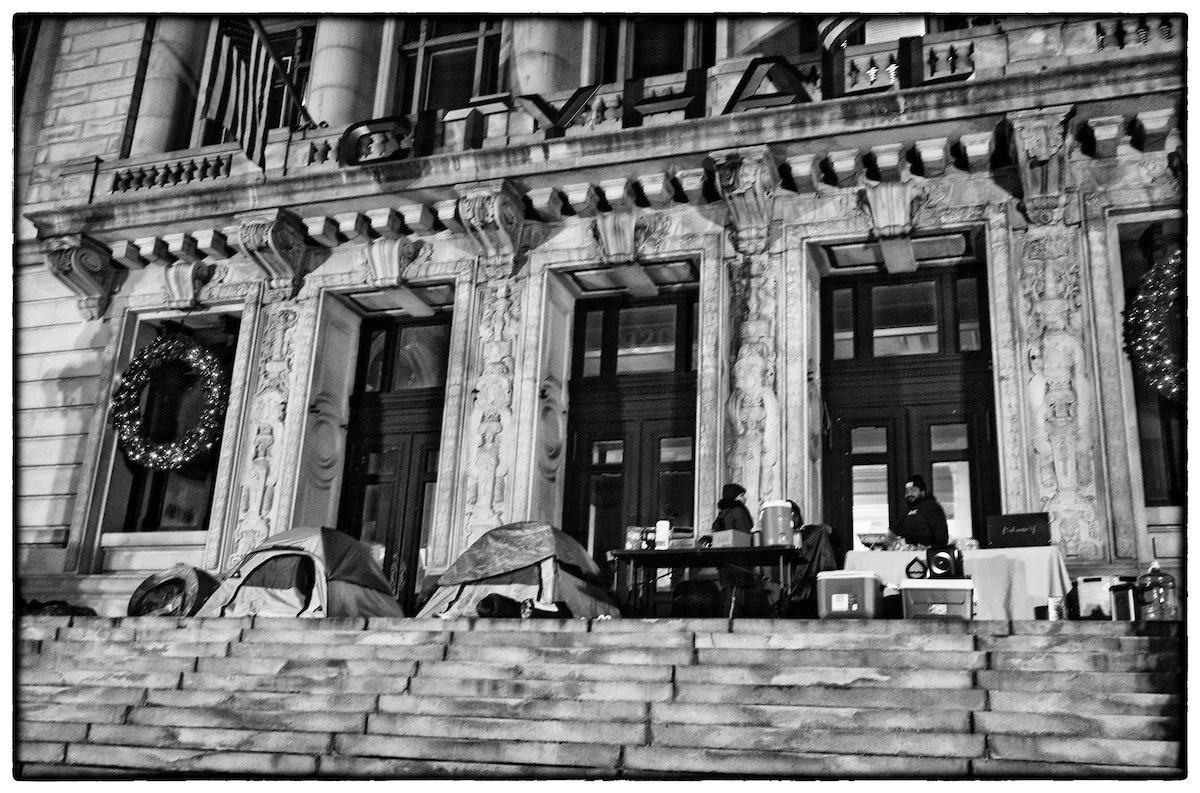
In December 2023, the Newark Water Coalition led a group of activists to occupy City Hall to draw attention to homelessness in Newark. Photo credit - Brian Branch Price
Newark just held another no‑contest election in which 11.89% of registered voters decided who governs a city of more than 320,000 people.
This is not an anomaly, but the operating condition of a democracy that has learned how to function without its citizens.
This is a city steeped in the language of resistance and revolution, where the yellow shirts of the People’s Organization for Progress march weekly on nearly every issue. Yet Newark continues to disassemble and devolve with all of our complicity.
Newark has 161,000 registered voters. Just 19,183 cast ballots. The elected will now govern on this new‑style mandate — if that is what we are prepared to call it. In what city, in what party, is this how democracy is supposed to function?
In New Jersey’s November 2025 gubernatorial election, turnout hit 51.4%, with 3.37 million ballots cast out of 6.55 million registered voters — the highest non-presidential turnout since at least 1998.
Nationally, the 2024 presidential election saw 65.3% of the voting‑age population cast ballots, translating to roughly 154 million voters, with 73.6% of eligible adults registered to vote.
The contrast between a mobilized national electorate and a disengaged local one underscores the fragility of democratic participation at the municipal level.
Gov. Sherrill received 173,765 votes in Essex County. Newark is the county’s largest municipality and has typically provided the single largest Democratic vote total.
Newark voters turned out to put Sherrill in the governor’s seat — yet at her first 100‑days talk at NJPAC, she never mentioned the four hospitals slated to close in Newark.
Consider that in the most populous city in the state — a dominant economic engine for New Jersey and Wall Street, with leading global corporate headquarters — the professional managerial class runs low‑voter‑turnout, no‑contest elections for a duopoly donor class on the backs of working‑class folks.
It raises the question of power and decision‑making: To whom go the spoils, and at what price?
Many were stunned by the low turnout in the Newark School Board elections just weeks ago. Some of us pondered the cost per vote for each young person who actually voted. It was typical. You get what you pay for in the rough business of winner‑take‑all capitalism.
You gut public education of the humanities and philosophy, use new‑age, trauma‑informed frameworks to train the minds of our young people, and then expect them to show up to claim power in the round. Hell, their parents aren’t even in the round. Mom and Dad are products of the town where 11.89% turned out on Tuesday, and just 3% voted in the School Board election.
Did the mayoral meeting held in the East Ward last week affirm who we are as a city, as citizens? I think it did. Presentations by seven contenders — except the officeholder — revealed a thin understanding of the city, governance, and, most of all, power. And the officeholder threw away his elegance in a room ripe for disarray.
So does this Newark‑style democracy portend the city’s damnation — a democracy designed and managed by the donor‑elite class?
Newark is telling the country something, and it’s big: Democracy dies for want of a civically engaged citizenry — not one beholden to the duopoly or any party. Or, as Thomas Paine petitioned at the nation’s founding, “We have it in our power to begin the world again.” That power, however, requires more than showing up.
If we are to accept that voting still carries the capacity to create leverage, then let’s consider this: Launch a citywide civics campaign where money isn’t the driver and there’s no political party contract at the end.
Wage a war against the decimation of civil society — low voter turnout, voting for party jobs and the donor class, the gutting of a learned polity, the narrowing of power, and the erosion of old‑school civics.
What more can we lose?
