
Delaney Hall, from largest East Coast facility to a hunger strike: How did we get here?
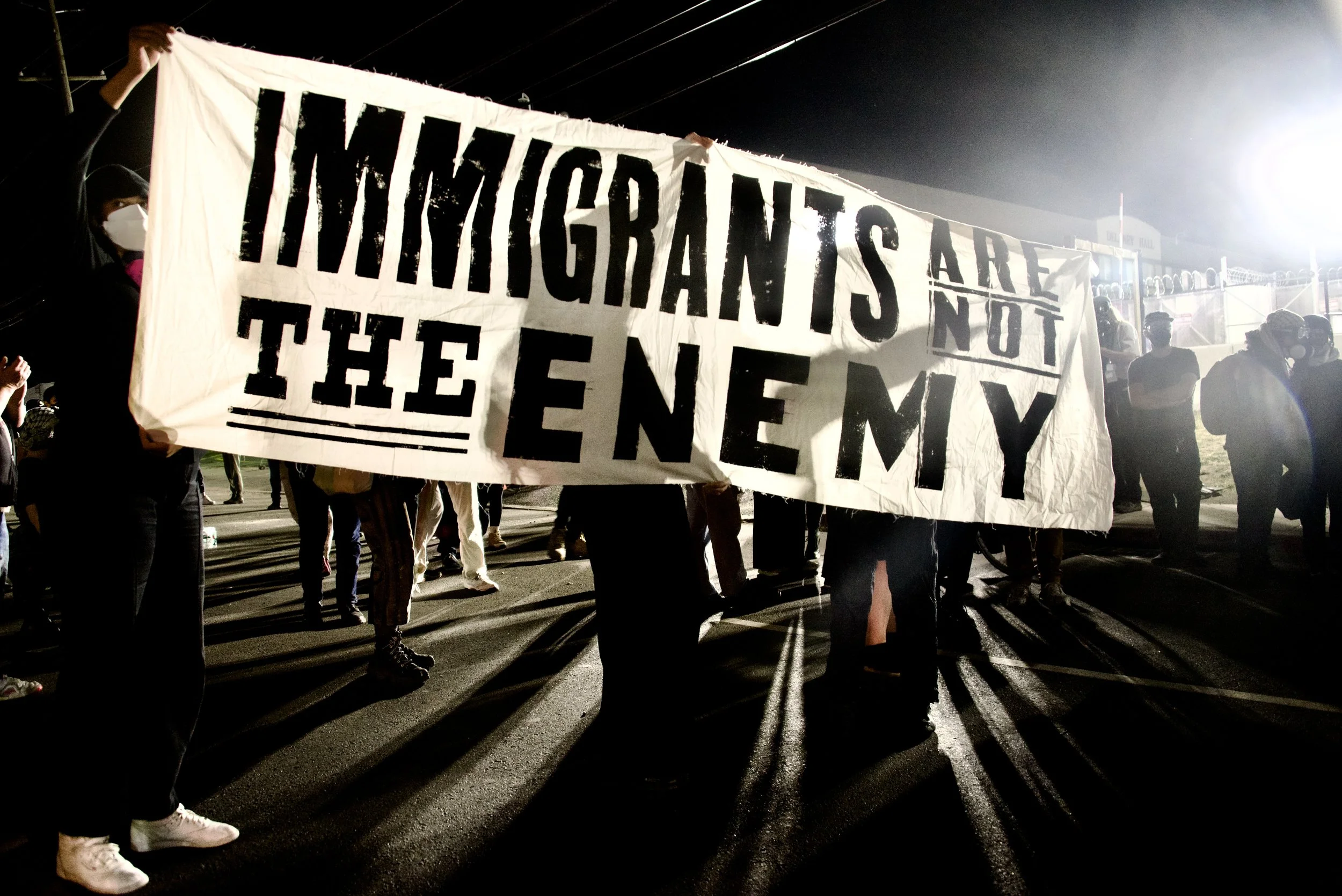
Protesters gathered outside Delaney Hall, Newark, NJ on June 3. Photo credit, Demi Guo.
News of the labor and hunger strike at Delaney Hall, the largest ICE detention facility on the East Coast, has gone international. But as the news cycle moves on, the original drivers of the protests outside Delaney Hall—immigration policy and the for-profit prison complex—remain largely unaddressed.
“They’re paying attention to what’s happening on the outside but not what’s happened on the inside,” Kathy O’Leary, USA ambassador for PAX Christi, said. O’Leary, who has been organizing outside Delaney Hall since it began operations last year, added that the focus should be on the detainees, who began striking to demand better living conditions and the observance of their rights.
Attorney General Jennifer Davenport filed a lawsuit against The Geo Group, Inc.—the private prison and mental health facility operator running Delaney Hall—to allow the New Jersey Department of Health (DOH) full access to the facility. The DOH had previously been allowed a limited inspection that did not include the medical unit or the sleeping, bathing, and toileting areas. And although federal inspections deemed Delaney Hall’s conditions “acceptable” last August, they still cited infractions for environmental health and safety and food service—two points detainees explicitly stated they were striking against.
“We were complying with legal requirements, and there was no order from a judge for our detention or arrest,” detainees wrote in a letter smuggled out of Delaney Hall. According to the letters, now that they were detained—despite many among them having lived for years in the United States with a clean record—they were served poor food, and those with medical conditions were not receiving proper care. “They are the brave ones,” O’Leary said. “They kept up their hunger strike as long as they could.”
Before the strike
To understand Delaney Hall’s growth and conditions, one has to go back to the 1980s, when the United States began rapidly expanding its prison system, and governments turned to private corporations to meet demand. This spread to immigration policy, resulting in the detention of Cuban refugees in the Mariel boatlift and Chinese migrants in the Golden Venture shipwreck. GEO Group had been in charge of the facility from 2011 to 2017, housing 450 immigration detaineesduring that period.
GEO Group was unable to renew its contract in 2017, and in 2021, former Governor Phil Murphy signed a law banning private companies from contracting with ICE. In 2024, during the final months of the Biden administration, the tides turned again. Private contractor CoreCivic sued the state of New Jersey, while GEO Group filed suit, and the court reversed former Governor Murphy’s ban. As of 2025, nearly 90% of ICE detainees are held in private, for-profit prisons, with CoreCivic and GEO Group operating the bulk of them.
The federal government entered a 15-year, $1 billion contract with GEO Group in February 2025 and reopened Delaney Hall as an immigration center. Throughout 2025, Delaney Hall has seen the escape of four detainees and the death of another. Over 10,000 people have been detained at Delaney Hall between May 2025 and March 2026.
In the press release announcing AG Davenport’s lawsuit, Governor Mikie Sherrill stated, “The people of New Jersey deserve transparency and accountability, and I will continue using all the power of this office to advocate for the detainees and their families." However, protesters like 34-year-old Dez Clark have yet to see her meet their demands. “The main thing is to free them, right? Shut this place down,” said Clark, who, on his first day at Delaney Hall, watched a truck coming out of the facility run over a protester's leg. In addition, Sherrill has not met with the strikers, though multiple officials, including Newark Mayor Ras Baraka, were arrested while attempting to access the facility and meet with detainees.
Growing the movement
According to an annual report detailing the contract signed in 2025, GEO Group would provide ICE with services, including security, maintenance, medical care, and legal counsel for Delaney Hall, and would receive over $60 billion annually in exchange. But a detainee made a statement to “The American Prospect” via Eyes on ICE New Jersey on the condition of anonymity, saying, “We were the ones who shoveled the snow during the winter, we are the ones who serve the food, we are the ones who clean the units, we are the ones who clean the bathrooms. We are not recognized or valued for our labor.”
Among the thousands of people detained at Delaney Hall in the last year, 70% have no criminal record, while 12% have criminal convictions, which is at odds with the Department of Homeland Security’s claims that their detention is to protect others from “murderers, rapists, pedophiles, and drug traffickers.” In addition, Delaney Hall is meant to be a temporary holding facility while detainees’ cases are processed, “and it’s just taking way too long,” Clark said.
The current movement started when families and loved ones of ICE detainees would come for visitation. Delaney Hall, located in an industrial zone by Newark Bay, does not provide parking or a waiting room for visitors, who would wait at the entrance to check in. Activists would wait on-site with them, providing them with water and umbrellas depending on the water. In addition, according to Rania Hatab, whose organization offered mutual aid assistance outside Delaney Hall last July, visitors could be denied entry for not meeting arbitrary dress codes. “So if somebody gets taken out for wearing slippers or whatever, they had shoes for them,” Hatab, who is an organizer with the Lower Hudson Valley chapter of the Democratic Socialists of America and the Rockland Coalition to End the New Jim Crow, said. “If they were wearing a dress and that was not okay, they had leggings for them.”
Eventually, the facility built a metal shack at the entrance to serve as a waiting room, but visitors would still wait for hours to be let in. In that time, activists would entertain the children and provide families with their company. “And then it got bigger. More people and community love,” Hatab said. “You had prayers and vigils that were happening here regularly.” People donated groceries, diapers, and baby formula. They offered to drive families to Delaney Hall and back.
Visitors were given no information about the procedure for seeing their detained loved ones. And many detainees were picked up at ICE check-ins, where immigrants would receive updates on their cases for residency in the United States—a legal process required regardless of whether they are documented or not. The activists would help visitors find legal resources “just to get their questions answered, just make sense of the senseless,” Hatab said.
A pattern across the nation
Though protesters would attempt to block vehicles transferring detainees, those who led the hunger strike have been dispersed across several other facilities throughout the country. But, O’Leary added, “they have the skills and knowledge to organize.” And when they organize again, activists will be outside the building offering support.
As of 2025, there are 212 active ICE detention centers across the United States, according to US Facts’ analysis of data from ICE. Each facility would be in a different location, and organizing people to advocate for detainees would require adapting to their environment. “People would say it’s hard to organize in the industrial part of Newark on a four-lane truck route, but it’s a different kind of difficult,” O’Leary said.
Since the hunger strike began, activists and loved ones have secured the release of a handful of detainees. “You have a hunger strike, and you can get as much attention as you can and get as much legislation as much as you can, but at some point the window closes,” O’Leary said.