Can West Orange Town Council ever ponder: “What to the oppressed is America” 250?
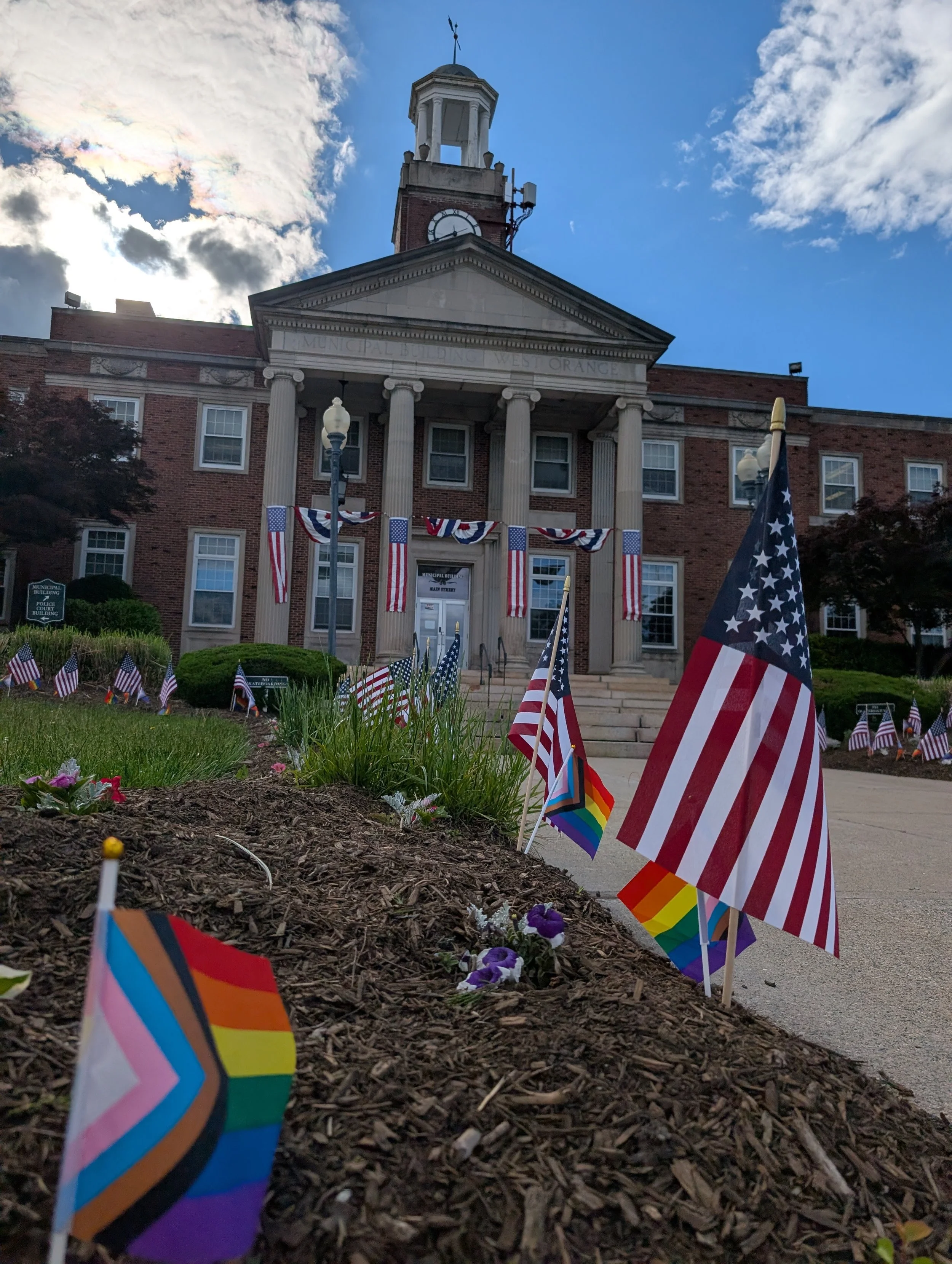
Progress Flags added by the community after West Orange removed the rainbow paint from the steps and put up USA flags, Matt Dragon, West Orange, NJ 05/15/2026
“What, to the American slave, is your 4th of July? I answer: a day that reveals to him, more than all other days in the year, the gross injustice and cruelty to which he is the constant victim. To him, your celebration is a sham; your boasted liberty, an unholy license; your national greatness, swelling vanity; your sounds of rejoicing are empty and heartless; your denunciations of tyrants, brass fronted impudence; your shouts of liberty and equality, hollow mockery; your prayers and hymns, your sermons and thanksgivings, with all your religious parade, and solemnity, are, to him, mere bombast, fraud, deception, impiety, and hypocrisy—a thin veil to cover up crimes which would disgrace a nation of savages,” —Frederick Douglass, “What to the Slave is the Fourth of July?” July 5, 1852
How we continue to affirm our colonial mentality
At the hyperlocal level, most of governing is about visibility. The elections have little to do with policy; they are much closer to a middle school class president than to a US president. They are popularity contests. Once elected, it’s an assembly line of attending events, smiling at ribbon cuttings, posting about every conceivable holiday, and talking to people at the library or town pool.
Part of maintaining “popularity”, at least in the mind of someone running for local political office, is avoiding pissing people off. The common interpretation of how to accomplish this goal is to just never do anything “controversial,” or at least what the voters may view as such.
As much as we decry national politicians for following the polls, representing hundreds of thousands of people legitimately makes it hard to get a sense of the needs of communities, especially the oppressed and marginalized, who need your help and the policies they are advocating for. At the local level, it’s easy to be misled by “popular” sentiment. I put that in quotes because things are rarely popular or unpopular in a vacuum. But sentiment is outside the quotes, because I mean exactly that. Largely emotional, non-rational, often reactionary energy. It’s the thing that makes local politics incredibly static, decrepit, and hard to get people interested in or excited about.
This setup lends itself to a binary structure that local politicians organize themselves around: Either move your voters, the town government, and the town’s residents in a direction that leaves things better than when you arrived, or be a reactionary, rarely raising your head above the parapet, and shrinking every time some small group you view as supporters is unhappy with your decisions.
Leadership is about moving public opinion, not following it. It’s about standing up for people who are viewed as outsiders or as lesser than, and not using your platform to oppress or minimize those people.
During May 2026 in West Orange, town employees were instructed to powerwash the rainbow flag off the Town Hall steps. The belated, nonsensical explanation referenced America 250, stating the steps needed to be fixed for the Memorial Day celebration as part of the 250th Anniversary events. Sure, repairing masonry might require a thorough cleaning first; however, it was clear the town had no plan to put it back after the repairs. The unwritten part of the explanation was that someone (the Mayor, the Memorial Day planners, bigots?) didn’t want to see a rainbow flag in their America 250 Memorial Day photos.
The West Orange Administration tried to erase our LGBTQIA+ neighbors, not with a bang, but with a high-powered mist. One could envision an ironic rainbow forming as the sunlight hit the spray. They did so without any plan for what would come next—without any emotional intelligence or foresight, their actions would immediately cause pain and engender a backlash.
Leadership would mean acknowledging that they hadn’t thought something through, agreeing to undo their mistake, and seeking dialogue with the affected population and accountability from voters in the next election. Instead, they went into crisis mode, fumbling around for vague, noncommittal language that would make those upset with the decision feel heard, perhaps, while also allowing those who support bigotry and hate to feel affirmed.
Most years, in most elections, we don’t elect leaders; we elect popularity chasers. Whenever something gets an ever-so-slight donor push back, they shrink away, saying “It’s not the right time” or “maybe next year.” That’s not leadership. Leadership is taking unpopular stances because they are morally, ethically, and equitably correct. Leadership is telling your supporters, you elected me to lead and make decisions, not to follow the political winds. Leadership is losing an election to win the war.
It’s not hard to see that the decision to throw LGBTQIA+ employees, neighbors, and students under the bus of “Yay, America!” aligns with our entire oppressive, genocidal history. We have, since before our founding, been a country in search of Empire: One built on ethnic cleansing, enslavement, violence, oppression, and strict racial and class hierarchy. Even within our othering, we pit marginalized groups against one another and elevate ourselves.
What still that haunt us on this day
Why did we, Europeans, ship Africans as cargo across the Atlantic Ocean rather than enslaving more indigenous people as we slaughtered them and stole their land?
So what are we celebrating, here, in 2026?
A country that bans pride sidewalks, steps, or flags?
A country that makes it illegal for women to make their own healthcare decisions.
A country that beats, arrests, and expels students protesting in support of their conscience?
A country that violently and illegally deports hundreds of thousands of hard-working, tax-paying, community-supporting neighbors?
A country that would rather push trans kids toward death by suicide than to let them see, much less find, their community?
A country that shrugs when first graders, still practically babies, are murdered in numbers higher than they can count, with a weapon designed to create such devastating injuries that opposing troops would die on the battlefield, before reaching medical care.
A country that illegally provides weapons, those child-killing guns and 2,000-pound bombs, airplanes, helicopters, drones, so, so many weapons, to a “critical ally” so they can kill children in unspeakable numbers, and for the “lucky” ones, membership in the largest pediatric amputee population in history.
We seem to have learned nothing from our first 250 years. 250 years of attempting to erase people, their lives, their cultures, their stories. 250 years of violence against others because that violence doesn’t work against our shame.
Given all the shame that American 250 represents, you’ll forgive me if I’m not in the mood for celebrating.
