Supporters march 103 miles to demand medical care and freedom for political prisoner Mumia Abu-Jamal
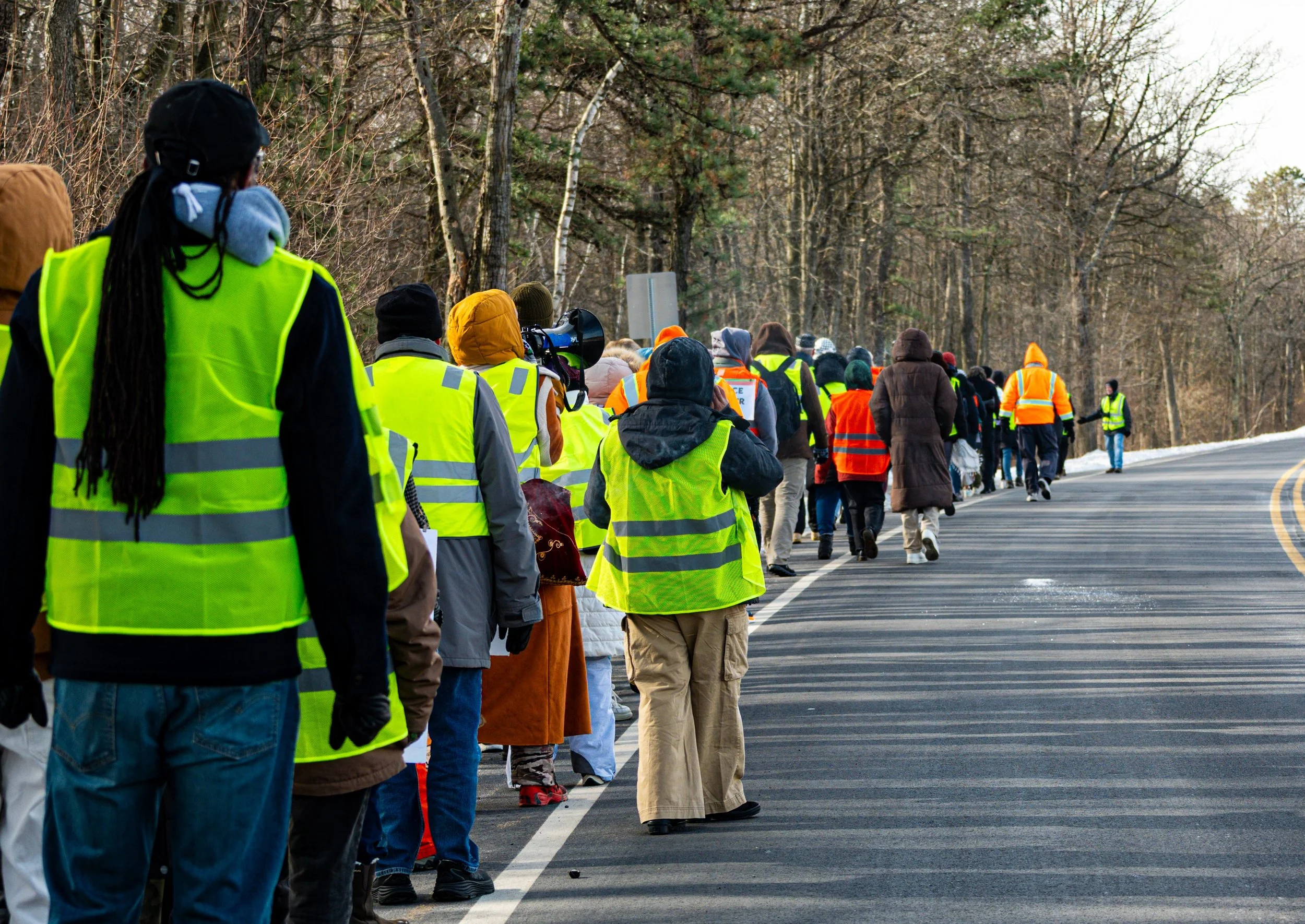
Supporters of Mumia Abu-Jamal march between Philadelphia and Frackville, PA. Photo by AB Youssef.
Frackville, PA - Supporters of political prisoner Mumia Abu-Jamal led a 12-day, 103-mile march demanding an end to medical neglect and elder abuse in prisons, as well as to free Abu-Jamal.
The march began on Nov. 28 in Philadelphia where Abu-Jamal was a member of the city’s chapter of the Black Panther Party and ended on Dec. 9 at the SCI Mahanoy Corrections Facility in Frackville where he is now incarcerated.
The final day of the march marked 44 years since Abu-Jamal was arrested for the murder of Philadelphia Police Officer Daniel Faulkner under dubious circumstances and later sentenced to death. Abu-Jamal has always claimed innocence in the case.
The incident, which stemmed from a traffic stop involving Faulkner and Abu-Jamal’s younger brother, took place during a time of deep racial tension between Philadelphia’s nearly-all-white police force known for its corruption and brutality and the city’s black neighborhoods where radical liberatory movements thrived. Such invidious instances, acutely familiar to people of color then and now, can become watershed moments, symbolizing broader systemic injustices. Such was the case for Abu-Jamal’s trial and death sentence.
His sentence was later overturned by a federal judge who cited improper jury instructions and prosecutors in 2019 agreed to reduce his sentence to life in prison. Since his arrest, Mumia Abu-Jamal has become an award-winning journalist, columnist, and author, and has been among the strongest and most influential voices for abolition and black liberation.
“There were primary goals and secondary goals [for the march]. Until Abu-Jamal gets the medical treatment he legally deserves, we have work to do,” said Zayid Mohammad, a Newark resident and member of the People’s Organization for Progress who helped to lead the action’s organizing efforts. “We were successful to make a modest breakthrough of the local media narrative – cop killer, cop killer, cop killer. It’s always been virulent. This is the beginning of some balanced reporting. We’re also picking up support from people who, years ago, wouldn’t have supported this. And we’re seeing, finally, some of the youth connect to this.”
Abu-Jamal, who spent 29 years in solitary confinement, was blind for eight months until receiving cataract surgery. More medical care is still needed to prevent him from permanent vision loss. Organizers with the Mobilization for Mumia have been holding regular organizing calls and sending daily letters to the Pennsylvania Department of Corrections, calling for a new physician to be assigned to Abu-Jamal’s case and for eye surgery to be scheduled. While demands for Abu-Jamal’s urgent medical needs are strong, organizers say that his story should call attention to the medical needs of incarcerated people nationally and internationally.
“There's something known as the Mumia effect, which is that resulting from this advocacy, he always gives us counsel to link his suffering to the suffering of others,” Dr. Ricardo Alvarez, medical counsel to Abu-Jamal, told Public Square Amplified multimedia reporters AB Joussef and Karen Dinkins at the march.
“He altered the standards of care of Hepatitis C treatment to prevent liver cirrhosis for other prisoners. And as a result, we are hoping that he will be able now to alter the standards of eye care so that other prisoners don't suffer unnecessary harm and blindness.”
According to a 2021 report from the US Department of Justice, deaths of incarcerated people over the age of 55 jumped from 34 to 63 percent between 2001 and 2019, with heart disease cited as the most common cause of death. And a 2017 study by the Vera Institute of Justice found that less than 3 percent of incarcerated people between the ages 50 and 65 re-offend. That number drops to virtually 0 for those over 65. In New Jersey, eight percent of people incarcerated in state prisons are over the age of 60, according to a 2024 Department of Corrections report. Currently, NJ incarcerates about 24,000 people, at a rate of 240
“When you’re in prison for 20 or 30 years and they don’t provide medical care and feed you what they feed you, it’s no surprise a lot of people have diabetes and hepatitis. We consider it elder abuse,” said Steven Bernhaut, a People’s Organization for Progress member who helped organize the March for Mumia. “There’s no reason those prisoners need to be kept in prison. We should be putting that money towards reentry programs and youth programs and let people out back to their families.”
The New Jersey Legislature passed a compassionate release law in Feb. 2021 for ill incarcerated people. However, to be considered for release they must have a terminal medical diagnosis or be permanently physically incapacitated. Fewer than 10 people have been released under this law since its passage.
A bill in the Legislature, and part of the “People’s Agenda” package of legislation, proposes allowing people aged 60 and up, or those who have been incarcerated for 20 years, to petition a Superior Court judge for early release.
“The problem is, the reforms of the system, the system is doing what it’s meant to do,” said Bernhaut. “It’s hard to know what can be reformed versus how we can start dismantling it. “
“I think what we want to do with the march is really remind ourselves that this movement is everlasting,” said Jian White, an organizer with the Jericho Movement, which works to free political prisoners. “That is like Clark James said, revolution is in the very air itself and that this is a fight that expands to every center of the American consciousness. The fight for freedom in Palestine extends to this, the fight against this immigration Gestapo that we're seeing pick people up on, off the streets.”
“Because it can become any of us at any time. We’re in a country that is drunk on mass incarceration,” said Zayid Mohammad, calling attention to New Jersey’s history of imprisoning political dissidents like Assata Shakur and Sundiata Acoli. “Wherever we see people being oppressed, it’s our responsibility to stand with them.”