High schoolers in NJ weigh in on ICE raids and immigration polices
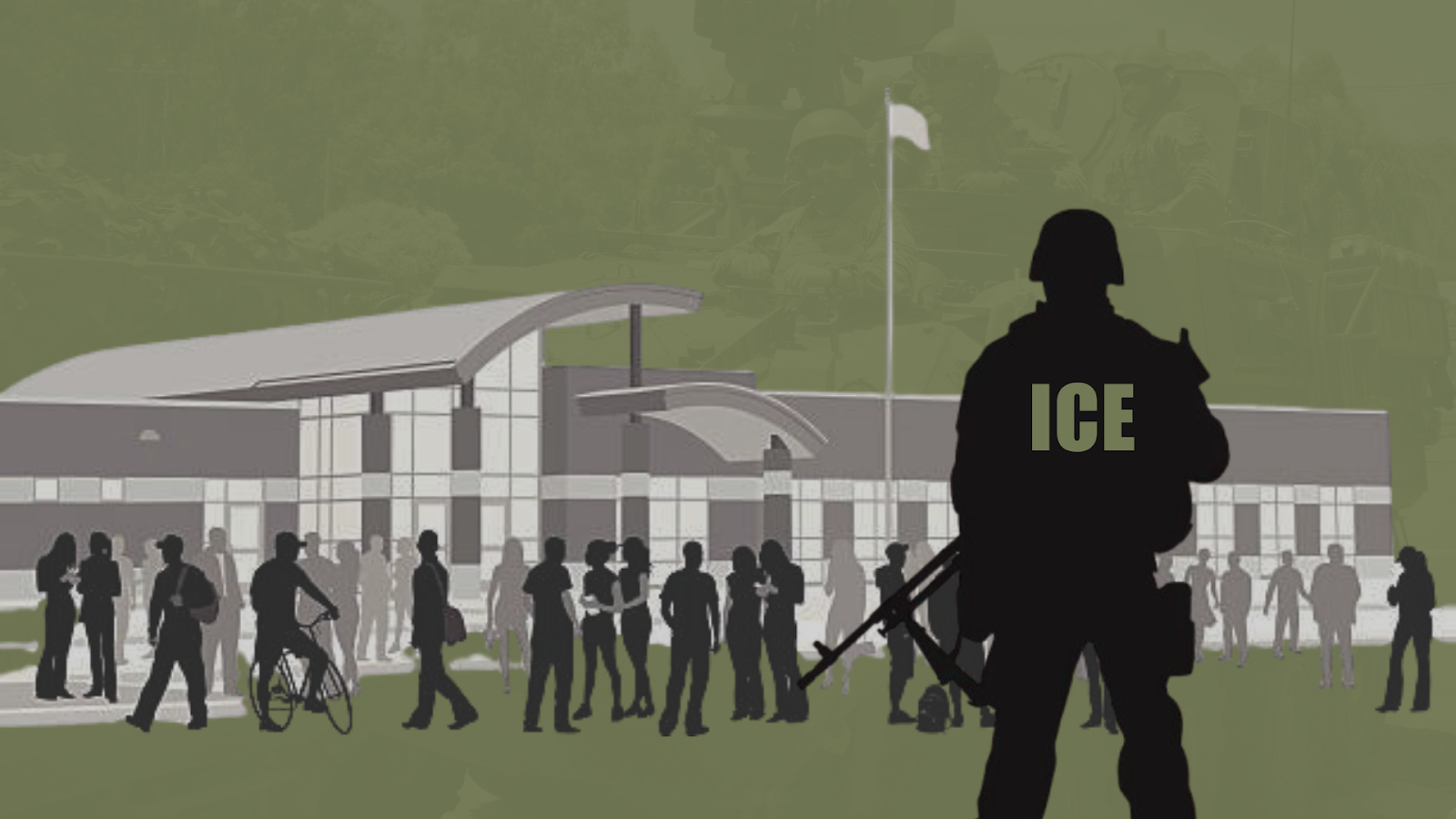
Illustration by Grace Kang
Public Square Amplified, in partnership with the Center for Cooperative Media, presents a three-part series on the role of current state and local policies as a tool to secure the rights of students facing immigration scrutiny.
Newark, NJ - With heavy weapons and a threatening presence, ICE is bringing violence into shared community spaces, including schools. Serenity Snead, a senior at Donald M. Payne Tech in Newark, New Jersey, says, “...they stand out; they don't look like regular police, they look like they're there to do something bad.” Across the nation, immigration enforcement is seeping into all corners of society, targeting essential workers, children, and students.
On November 19, 2025, ICE agents raided the Ocean Seafood Depot in Newark, NJ, a wholesale market for seafood distribution. Equipped with weapons, military gear, and face masks, ICE arrested 13 employees. Just two weeks earlier, in Avenel, NJ, the Savino Del Bene warehouse was raided, resulting in the arrest of 46 workers. Immigration activists claim that even people with legal work permits and pending immigration cases were taken.
Further ICE sightings have been reported at grocery stores, fire departments, restaurants, and patrolling through neighborhoods, often documented on social media. Despite some of these reports being discredited as false alarms, the confusion contributes to the fear overwhelming New Jersey communities.
As ICE encroaches on ordinary day-to-day life, its actions raise the question of where ICE will strike next, and with recent policy changes, schools have become a plausible target.
An increasingly anticipated threat looms over New Jersey communities as neighboring cities face the deportation of students. In Astoria, Queens, New York, community members rally at the elementary school playground of 6-year-old Yuanxin Zheng. Yuanxin and his father, Fei Zheng, were arrested at a routine check-in. When detained, Yuanxin was forcibly separated from his father and Fei remains uninformed about where his son is.
Meanwhile, in Minneapolis, Minnesota, a student of Augsburg University was detained on campus. Videos show several unmarked vehicles and ICE agents, masked and armed with rifles, right outside a residence hall. Campus security confronted the agents, and the provost claims they did not have a judicial warrant, yet proceeded with the arrest. The statement from the DHS provides how the school administrator and security blocked the vehicle from exiting, asserting that ICE was violating university policy. During this confrontation, university officials claim ICE agents pointed their weapons at students.
The Augsburg community is deeply shaken by the arrest of one of their undergraduate students and the fear that ICE brought on to the school campus. ICE tactics, pointing weapons at students, for the purpose of immigration enforcement makes the implicit threat of violence imminent.
Since 2011, the presence of ICE in schools was unthinkable. Under the law, places like schools and churches were considered “protected areas”, outlawing any immigration enforcement actions taken at or near these locations unless certain exigent circumstances arose. However, on January 20, 2025, when Trump was sworn into office, he rescinded Biden’s "Protected Areas" memorandum, making legally binding guidelines for ICE nullified.
Instead, the DHS claims they are entrusting ICE officers to “use [their] discretion along with a healthy dose of common sense.” The implications of these policy changes reach beyond school zones; they reflect the overall lawlessness surrounding current immigration enforcement.
Landmark Supreme Court cases, such as Plyler v. DOE, along with current federal and state legislation, declare that all students have a right to education regardless of their immigration status. These schools are mandated to provide a welcoming environment, free from discrimination. However, with this rescinded policy and increasing threats of deportation, family separation, and traumatic confrontations, immigrant families are hesitant to send their children to school.
The incident at Augsburg reveals the dangerous implications of Trump’s policy already unfolding in reality. Although instances of ICE raids on school campuses haven’t been seen in New Jersey yet, as ICE expands its crackdown into community spaces, an unsettling fear sweeps through New Jersey communities. Students and families are left questioning what protection they have and how they can prepare.
As a New Jersey high school student, deeply involved in discussions of immigration policy, I have recognized the need for a platform where young people can make their voices heard. In the following conversations with five New Jersey high school students, I gained insights into youth perspectives on recent immigration policy and its effects on education. Our voices illuminate the need for humane and community-oriented policy. Out of fear of being identified, some students agreed only to provide their initials. Interviews have been edited for clarity.
Public Square Amplified Community Reporter Grace Kang asked a group of young people from a group of high schoolers in NJ for their thoughts about the current immigration policies and their views on the importance of immigration policy. Here is what they said:
Q & A with New Jersey High Schoolers
Name: Serenity Snead
Age: 17
School: Donald M Payne Tech
Town: Not given
Nationality: US Citizen (Latino; US-born)
Grace Kang: How has the current immigration policy impacted your school?
Serenity Snead: There was an incident where ICE agents were around my high school during the end of the day, and a lot of kids were scared to leave because they were worried about something happening. I feel like ICE was just there because they know that a lot of Hispanics go to my school. It makes us feel like it’s not really up to us to help because it's gonna put ourselves in danger to do that.
GK: So, there is a sense of fear in the school environment over the presence of ICE?
SS: Yes, even going to downtown Newark after school. You feel like they're there even when you can't see them. They’re walking around hidden in public, which is nerve-racking—they could come out at any time. Looking at the news now, they're taking people anywhere, out of work, school, you could be eating a sandwich at a store, and here they come. So I’d say we're always looking over our shoulder.
GK: As a U.S. citizen, are you concerned about your classmate's safety?
SS: I am, because a lot of my classmates and friends are immigrants. Even if they aren't my friends, they're still my peers, so I care about them and wouldn't want anything to happen to them. So it's not only me worried about myself, but also for others. I see them every day, and if I don't see them in school, I worry, “Where did they go?” and I wouldn't want to see them on the news.
GK: If you had a chance to speak to your governor or your legislators, what would you want them to do? How do you think that they can best protect you?
SS: Even if they can’t prevent ICE agents from coming onto our schools, at least let the kids who are scared for their safety go home early or have transportation to make it home without being worried. Also, my representatives need to hold ICE accountable for profiling because, in reality, most of these Hispanics are legal. It's not right to pull someone off the street just for fitting a certain profile when these are people who haven’t done anything bad, especially students just trying to get an education. They need to do more thorough background checks.
Name: Mujeeb Tukur
Age: 17
School: Newark Tech High School
Town: Irvington, NJ
Nationality: Nigerian (Permanent resident)
Grace Kang: How do you feel about immigration policy today?
Mujeeb Tukur: I feel like it's crazy and one-sided in favor of the rich white people. Deportations are carried out randomly and unnecessarily, because most of the immigrants that are deported are the ones who help make America what America is. Before, people were getting deported for doing stupid things, or they were criminals, but now people are getting deported for no reason.
GK: If ICE does end up expanding in New Jersey and even going on to school campuses, what position do you think teachers and principals should take?
MT: I feel like principals should not allow ICE to come into the building, and even if ICE does, teachers should be the ones who stop ICE from entering the classroom. Teachers should be in defense of the students, no matter what the student is. ICE shouldn’t even be able to find out if you are an American citizen or not.
GK: Who do you think should face deportations, and who should be protected?
MT: The only people who should face deportations are people who are illegal and have felonies. If you don't have a felony, if you're not a criminal, you shouldn't be being deported—no matter if you're illegal or not, because we’re all from the same Earth, we all bleed the same.
GK: If you had a chance to speak to your governor or your legislators, what would you want them to do in this situation?
MT: Open their eyes and instead of thinking about how they can make more money for themselves doing this, think about how it affects everybody else—how it affects kids. I know some kids might be citizens because they were born here, but their parents are illegal. So, when you deport a parent, what will happen now?
Name: KY
Age: 17
Town: Edgewater, NJ
Nationality: South Korean (Student visa)
GK: How do you feel about immigration policy today?
KY: I think it has to be executed more moderately. There obviously needs to be restrictions, but there’s excessive violence against innocent people, including protesters. And now, I feel it’s the first time the government's openly talking about deportations. I don't really think that at any other time immigration policy was actually this public, or at least made it to this level of severity and national attention. They kept it on the down low, but now ICE is less discreet; they’re seen everywhere. My sister tells me about ICE agents even around her college.
GK: What are your thoughts on how deportations are being carried out?
KY: You can't really stop deportations, in my opinion, because they are technically breaking the law, but there has to be a way to do it in the most humane way possible. If you're here illegally, though, I don't think there's anything you can really say to defend your deportation, unless the system has blocked you after trying to get some sort of permanent residency.
GK: Are you aware of ICE going on to school campuses, and how do you feel about that?
KY: It’s not a good idea at all. I don't think they should be invading schools because it's supposed to be a safe place, and just their presence may threaten people, even if they're not criminals or illegal.
GK: Do you think that students or teachers should be deported, even if they came here illegally?
KY: They committed a crime by getting here illegally, but I don't know, it's such a complicated issue. I feel like it’s about both morals and law; it's a gray area.
Name: SK
Age: 17
School: Edison High School
Town: Edison, NJ
Nationality: Indian (Student visa)
GK: As a legal immigrant yourself, how would you explain the process of obtaining legal immigration status?
SK: People don’t understand how hard it is to secure “legal status” in this country. Instead of the inhumane policy of deporting immigrants, holding them captive, and taking away their visas, we as a country have to focus on reforming the immigration system. So it's more accessible, so more people can take advantage of the opportunities America offers without overwhelming the system. Our system is so backed up, but the immigration agenda right now is doing nothing to reform immigration itself and is instead focusing on harming people.
GK: What are your thoughts on deportations and who you think should be deported, or the extent to which deportation should take place?
SK: I've never felt unsafe that I, my friends, or classmates could get deported because I believed that if you followed the law and did the right thing, there would be no reason for even the possibility of deportation. With these recent administration changes, I now have concerns. I live in Edison, which is a very diverse area. Middlesex County is diverse. Central Jersey is diverse. And diversity is so important in our communities, but now it's making us a target. There have been so many families who have been living here for years and have been torn apart due to different immigration statuses. Honestly, the only time I would support a deportation is if it's a criminal who actively harmed another person. But even so, the rhetoric that is pushed of “all immigrants are criminals” is inaccurate and not the case for most immigrants in the United States.
GK: The current administration rescinded a previous law that deemed school zones to be protective areas, meaning ICE was not allowed to enforce immigration actions within the school zone. Instead, we are now relying on ICE to use its discretion on when and where to act. What are your thoughts on this policy?
SK: When I think of a school, it's a place where students and children go to learn, make connections, make friends, and explore extra activities. When you mention ICE entering school campuses, that instills so much fear, regardless of whether you're an immigrant or a citizen, a green card holder, or undocumented. Rescinding that policy is just another way to make people fearful in their own shared spaces where they find community. I don't support the reversal of this policy, given that schools are supposed to protect, not just legally, but be true places of safety.
GK: Do you feel that in any way your voice or your freedoms are limited because of the recent immigration policy changes and your immigration status?
SK: Of course. Even right now, I'm asking you to conceal parts of my identity because I am scared. I don't know what would happen if someone who is potentially in the Trump administration or anti-immigrant found out that I was commenting on immigration policy, even when speech is protected by the First Amendment. I have to step back and rethink what I put out on social media as well, especially when it comes to political content that I used to frequently repost.. I’ve even had conversations with my family to be careful with what we're saying and to be more reserved. We’re especially worried because I have a younger sibling who’s an American citizen, so if something were to happen to us, I don't know—would they have to stay here? It's just a scary thing to think about.
Name: VL
Age: 17
Town: Norwood, NJ
Nationality: South Korean (Permanent resident)
GK: What are your thoughts on the recent immigration policy, and has it affected how you live your life?
VL: Definitely; my family is living in fear. My father literally tells me to keep a photo of my permanent resident card with me everywhere I go. He has photos of his passport and his permanent resident card on his phone, and he keeps them ready because even at his own workplace, it's been a threat. A lot of my own friends who are immigrants also stay in a constant state of fear. I understand and relate. I feel that I should be safe as a permanent resident, but even then, there's still the risk that, regardless of my actual status, a racial component drives deportations. I just shouldn't be feeling fear in my national home.
GK: Do you feel in any way that your freedoms or voice have been limited by recent changes in immigration problems?
VL: Absolutely. I'm so hesitant to even like a social media post that might show any sort of defiance against the Trump administration. I'm nervous, I really just try to make my presence on social media and the internet as minimal as possible. It gets to the point that even if I say the word “Trump” in my text messages, I delete it right after because I'm that fearful. My mom is paranoid as well. My sister is too. We all are. And it's saddening because I want to stand up, I want to protest for so many of these causes that I believe in, but I can't because I'm scared to show my face in those moments and be identified.
GK: If you had a chance to speak to your governor or legislators, what would you want them to do in response and how do you think people in political power can best protect you as a student?
VL: The first step is to show that we don't agree with what’s happening—that the inhumane nature of ICE raids and rescinding these laws are not what we as Americans believe in.